
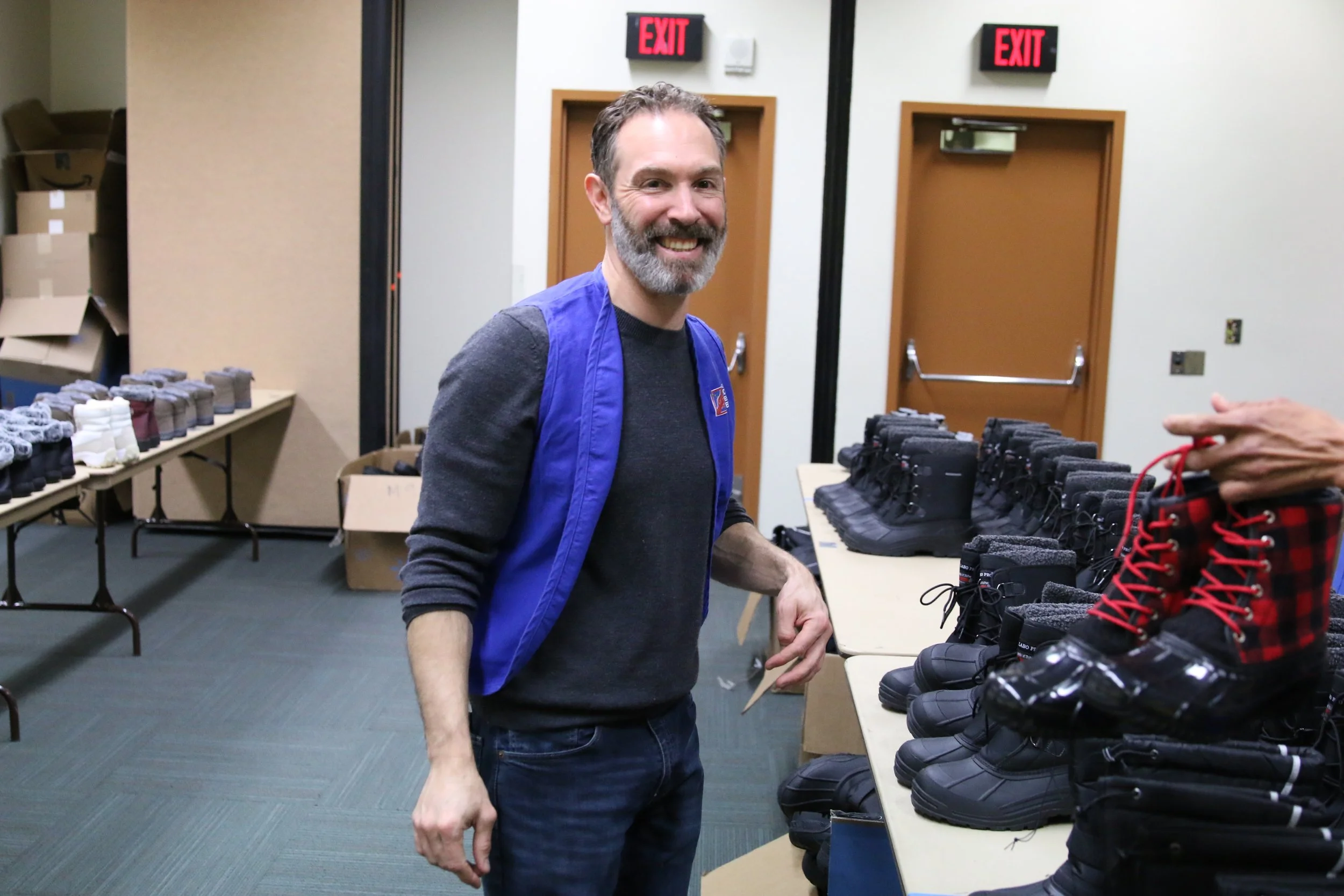
ACEH Board Chair Gabe Layman helped to distribute winter gear during Project Homeless Connect in September 2025.
What goes unseen
A message from Board Chair Gabe Layman
Our community often focuses on visible homelessness — people living in camps, sleeping in doorways, and enduring harsh conditions in public view. But most people experiencing homelessness are invisible to the public.
At the Anchorage Coalition to End Homelessness, we see ourselves in that unseen reality.
Just as many of our unhoused neighbors are quiet participants in the Homelessness Prevention and Response System, much of what ACEH does takes place behind the scenes.
Service providers and government partners may do excellent work on their own, but our system can only be excellent if it is intentionally coordinated. That is the work of ACEH, every day. We are system builders.
Our team oversees the Coordinated Entry program that helps people with the greatest needs rise to the top for scarce housing resources. We ground our strategies in real-world information, refining how we collect and use data to identify gaps, needs and trends. We bring people together — hosting conferences and trainings that strengthen both infrastructure and human capital — and we work alongside partners to ensure supports are centered in the needs of individuals.
In this dynamic environment, characterized by a dramatic change in federal priorities and processes, ACEH provides stability and technical guidance for community organizations on the front lines.
We work closely with our sister agency, the Alaska Coalition on Housing and Homelessness, to strengthen the system as a whole. We join with the Municipality of Anchorage to coordinate street outreach and respond quickly to life-threatening situations such as this winter’s dangerous cold. We support the Anchorage Continuum of Care Advisory Council, which helps shape better approaches through collecting and evaluating data, clarifying community priorities, and engaging key stakeholders, including members of our business community and people with lived experience.
Last year, we elevated Alaska-specific issues in conversations with Secretary Scott Turner of the U.S. Department of Housing and Urban Development and his team, both in D.C. and in Anchorage.
The roots of homelessness often stretch back years, even decades. Solutions aren’t instant, but we know the earlier we act, the better the outcomes. In 2026, we expect to lean into prevention work to help people before they suffer the trauma of homelessness.
Systems don’t build themselves. They are held together by people — by shared responsibility, steady effort and a recognition of the hard work that often goes unseen. Thank you for being part of that work.
Warmly,
Gabe Layman